
The mathematics of pelmeni
Today I found myself frustrated by a most unexpected thing: neither a person nor a force of nature, but the purest and most beautiful thing we have – a pelmen.
The pelmeni delivered to me were roughly a centimetre in diameter. I hadn’t noticed this detail in the photograph, because I was ordering perfectly ordinary meat dumplings, with no intention of participating in their miniaturisation.
So there I am, boiling these little things and swearing, when it dawns on me: as a dumpling shrinks, the ratio of meat to dough changes. And in an entirely undesirable direction. Your humble servant has, in other words, been swindled most indecently!
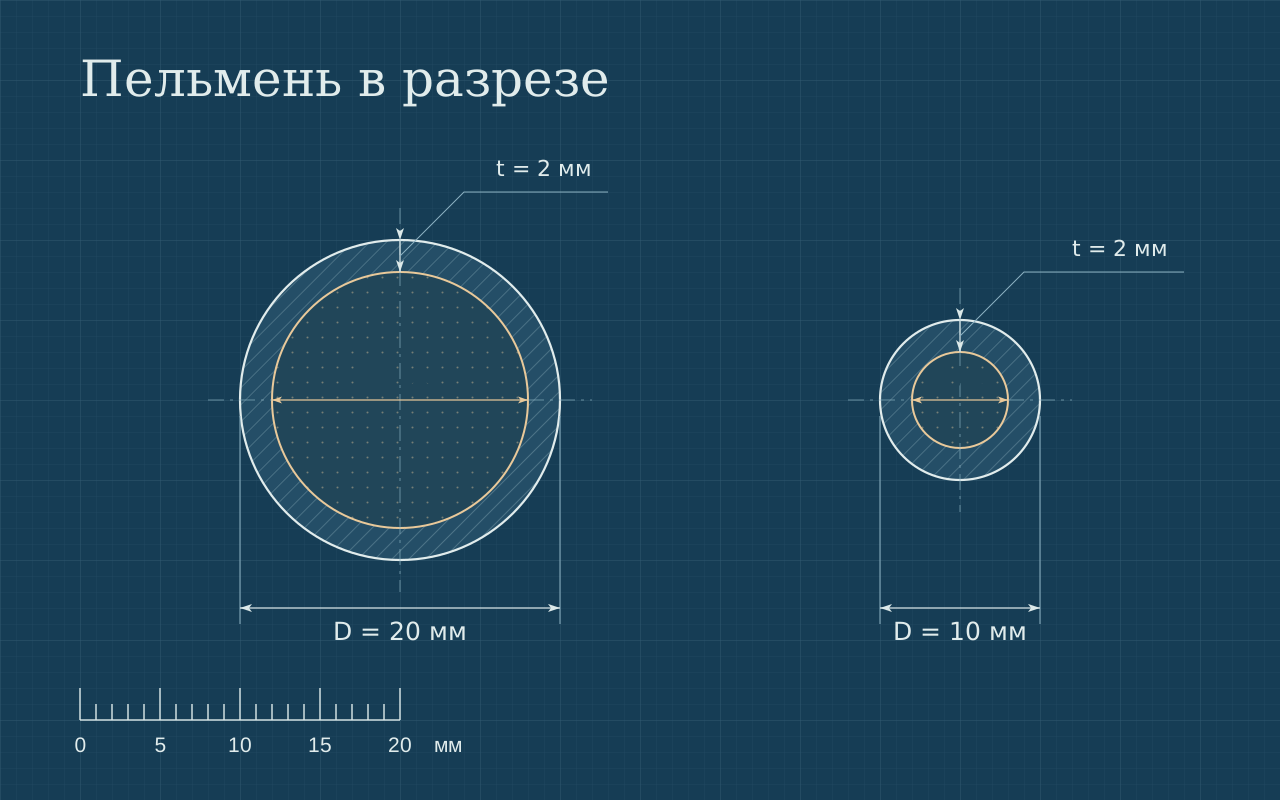
The maths is simple. Watch these tricksters’ hands: halve the linear dimensions and the surface area falls by a factor of four, while the volume falls by a factor of eight. But nobody is obliged to roll the dough twice as thin to match the smaller dumpling! This is where the consumer’s difficulties begin.
I’m not accounting for the broth inside separately: we’re calculating a raw dumpling, tightly packed with filling. Whatever happens to it in the saucepan can remain uninvestigated for now.
For the calculation, let’s treat our dumpling as a sphere. Yes, a spherical dumpling in a vacuum. Call its diameter D and the dough thickness t. The volume of the whole dumpling is then:
The filling’s diameter is smaller than the dumpling’s by two thicknesses of dough. So in the formula for the filling’s volume, we replace D with D − 2t:
The proportion of filling comes out as:
I haven’t actually measured the dough thickness. Let’s say two millimetres, or t = 0.2 cm. For a two-centimetre dumpling:
51.2% filling by volume. We can live with that. A proper amount of meat, on the whole: more than half.
Now take a dumpling one centimetre in diameter:
21.6% filling by volume. The rest is dough. Dough! DOUGH! When I ordered pelmeni, I was counting on a more active contribution from the chicken.
And I pay by the kilogram. So do you, incidentally. They will, of course, give me more dumplings, in number. But the number of individual instances of meat being present interests me considerably less than its total mass. They could make them smaller still. You’d get grains with memories of a meaty aroma. Something like those chicken-flavoured crisps from childhood.
I immediately suspected an economic motive and set about calculating what the manufacturer stood to gain.
For a rough estimate, let’s give the meat and dough the same density, so that volume fractions can stand in for mass fractions. We’ll price the dough at 11 Belarusian roubles per kilogram and the minced chicken at 18. A kilogram of two-centimetre dumplings then costs, in ingredients:
And a kilogram of one-centimetre dumplings:
That gives us roughly two roubles saved per kilogram, at our assumed prices and with our assumed dumpling construction.
I had expected to uncover a more substantial fraud. As it stands, my level of indignation seems to have exceeded the actual problem somewhat. Economically, at least. Then it occurred to me that somebody still has to manufacture these tiny things. Get the filling into each one, seal it up, lose nothing along the way. Perhaps that’s where all the savings on meat go. I haven’t studied the manufacturing process, admittedly. I was having lunch, after all, rather than conducting an on-site inspection, as any normal, mentally healthy person would.
Mathematics for a healthy person and a writer!